
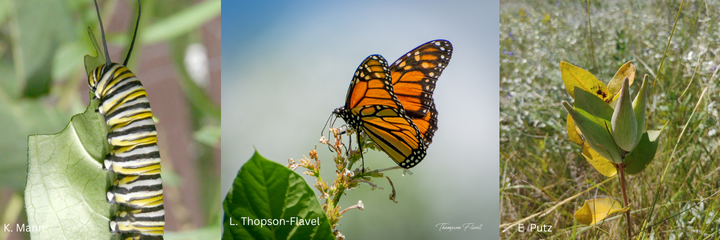
A Royal Return- Monarchs are back in Saskatchewan!
As Summer officially kicks off on the prairies, Saskatchewan residents are not the only ones soaking up the sunny rays. The Monarch, our largest and most iconic butterfly, is back in the province to start off the next generation of its life cycle.
The Monarch’s showy black and orange colouration warns predators away, telling the world that it would make a very bitter meal. This toxic quality comes from the plant it spends half of its life cycle on- Milkweed. “The Monarch’s return coincides with the Milkweeds emergence and leafing out,” Emily Putz, Habitat Stewardship Coordinator for Nature Saskatchewan’s Monarch programing notes, “right now, with the Milkweed really starting to grow, it’s a great time to check the underside of leaves for the first eggs and caterpillars of the year.” Monarch eggs are laid singly, usually on the underside of leaves and have a distinct ridged oval shape that comes to a sharp point. Caterpillars display bold colouration to warn of their toxic taste, displaying bands of black, yellow, and white. Both are only found on Milkweed.
“Speaking of Milkweed”, Putz continues, “If you want to promote Monarchs in your space, you will want to be sure to plant native Milkweed species and stay away from species that are not native to our province.” Saskatchewan has five species of native milkweed; many of which, like Showy, Common, or Dwarf Milkweed, can be found through local garden nurseries that sell native plants. Our native milkweed evolved with Monarchs and is best suited to support their full life cycle needs with the proper growth timings. Species to stay away from include Tropical Milkweed, which can spread harmful parasites, and species that are native to more eastern ranges and bloom with different timings such as Orange or Few-flowered Milkweed. “When in doubt, go with a species that already calls Saskatchewan its home!” Putz concludes.
Other ways you can support monarchs include planting other native flower species, such as asters and goldenrods, nearby your milkweed patch, stay away from any captive breeding (even catch and release can be harmful), and to report any sightings of Monarchs to Nature Saskatchewan’s Stewards of Saskatchewan program. Monarchs were officially listed as Endangered in late 2023 and every sighting on this species helps inform their population and range estimates, which can aid in recovery. All personal information from species sightings is kept private.
If you have any questions about the Stewards of Saskatchewan program, or would like to learn more about the Monarch, please contact Emily Putz at 306-780-9832 or EMAIL.