
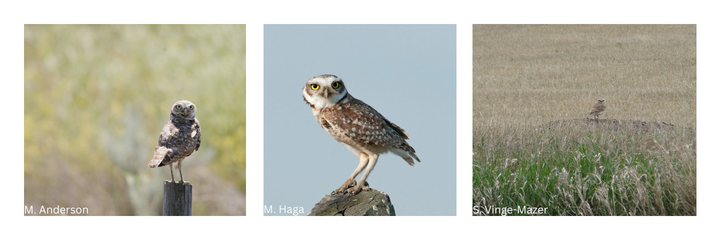
Burrowing Owls Return to Saskatchewan
Now that spring is here and farmers are returning to their fields, it’s time to be on the lookout for Burrowing Owls. The endangered owls have returned from their wintering grounds in southern Texas and Mexico to raise their families across the prairies. With breeding season well underway, Burrowing Owls are now pairing up and selecting their nests where they will soon be laying and incubating their eggs.
Despite their name, Burrowing Owls do not dig a burrow themselves. Instead, they use abandoned burrows that have been excavated by ground squirrels, badgers, or other burrowing mammals. Each spring, female Burrowing Owls lay 6-12 eggs, with 9 being the average. Because there is thought to be as few as 270 breeding owls throughout Canada, the success of each nest is important to the survival and recovery of this species.
Historically, Burrowing Owls nested in open expanses of grassland. However, over the years our landscape has changed, and the owls have adjusted by nesting in cultivated fields and roadsides where they often find a suitable burrow in the spring. Grace Pidborchynski, Habitat Stewardship Coordinator at Nature Saskatchewan, explains why: “Agricultural fields, particularly in the spring when the fields are newly plowed and before crops grow tall, can draw owls in since they like short vegetation to detect and capture prey”. Ditches can be acceptable foraging and nesting areas as they often have a mix of vegetation that attracts small mammals and insects for the owls to eat.
“Many producers across Saskatchewan keep an eye out for these small owls in the spring as they return to pastures and cultivated fields throughout the province; however, we can never have too many people watching for the owls,” says Pidborchynski. Nearly 350 landowners across southern Saskatchewan participate in Nature Saskatchewan’s Operation Burrowing Owl, helping conserve grassland for the owl and other prairie species. Participants in the program watch for the owls’ return in the spring while continuing their regular land management practices, including grazing which benefits owls as it keeps the grass short.
Nature Saskatchewan records sightings of Burrowing Owls to help determine distribution and population trends across Saskatchewan. “Without the voluntary efforts of ranchers, farmers, and the general public, recovery of this unique little owl would not be possible”, says Pidborchynski. She encourages the public to report any sightings of a Burrowing Owl by calling 306-780-9833 or email Operation Burrowing Owl. Personal information is kept completely confidential and never shared without permission.