
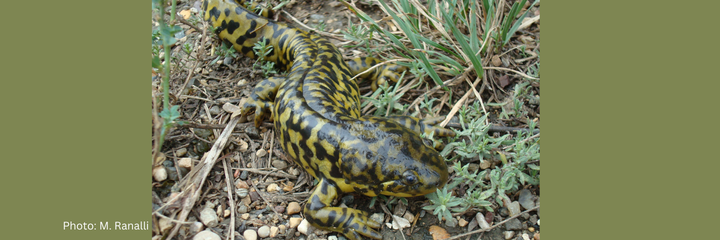
Tigers on the Prowl-Tiger Salamanders in SK
Whether its birds flocking, mammals gathering or insects swarming, late summer is the season critters get moving! There’s one more often overlooked creature that is also on the move this time of year, the Tiger Salamander.
The Western Tiger Salamander is Saskatchewan’s only salamander species and the top aquatic predator in our province’s fishless waterbodies. Young Salamanders display a bold black and yellow/cream striped pattern that generally fades and merges with age; older individuals a more uniform olive green to grey. As an amphibian, this species spends part of their live cycle in aquatic habitats (water) and part of it in terrestrial habitats (land), meaning they rely on both to have a successful breeding season and survive the winter. “The Tiger Salamander larvae are completely aquatic,” Emily Putz, Habitat Stewardship Coordinator at Nature Saskatchewan explains, “in our prairie pothole wetlands, the larvae and adults both cover an important niche, controlling insect populations in spaces that don’t host fish.”
This dual life cycle comes with many threats however; Salamanders share water habitat with pest insects such as mosquitos and are particularly susceptible to aquatic insect pesticide control. Their habitat is also increasingly disappearing, both the terrestrial native prairie where the adults overwinter, and the rapidly disappearing small wetlands that used to dot our landscape as they are drained to allow more agriculture. Salamanders across Canada are also struggling with a virus that is hitting already vulnerable populations. “Mid to Late August hosts its own particular risks to this species,” Putz continues, “while adults overwinter in small mammal burrows close to their breeding ponds, juvenile salamanders, those that just got their legs and emerged from their birth ponds, migrate in late summer, as they look for new areas to call home. They often come in conflict moving across roadways this time of year and are not fast enough to avoid oncoming traffic.”
The Western Tiger Salamander, while still locally common in Saskatchewan, is a listed species-at-risk specifically listed as Special Concern. “If it is safe to do so, and a salamander crosses the roadway in front of you, slow down and take a minute to avoid them.” Putz concludes, “Saskatchewan is this species stronghold in Canada, and we want to do everything we can to help them along in their recovery.”
If you spot a salamander, you can report your sighting the Nature Saskatchewan’s Stewards of Saskatchewan program, which tracks species-at-risk populations in the province. All sightings are kept private and never shared without permission. Sighting records can go towards tracking population and range fluctuations, aiding recovery. If you have any questions about the Stewards of Saskatchewan program or would like to learn more about the Western Tiger Salamander, please contact Emily Putz at 306-780-9832.